

Why Cost-Effective Renewable Energy Matters Now
The most cost effective renewable energy sources have fundamentally changed the economics of power generation. According to the latest industry data, renewables now significantly undercut fossil fuels as the world’s cheapest source of electricity.
Quick Answer: The Most Cost-Effective Renewable Energy Sources (2024)
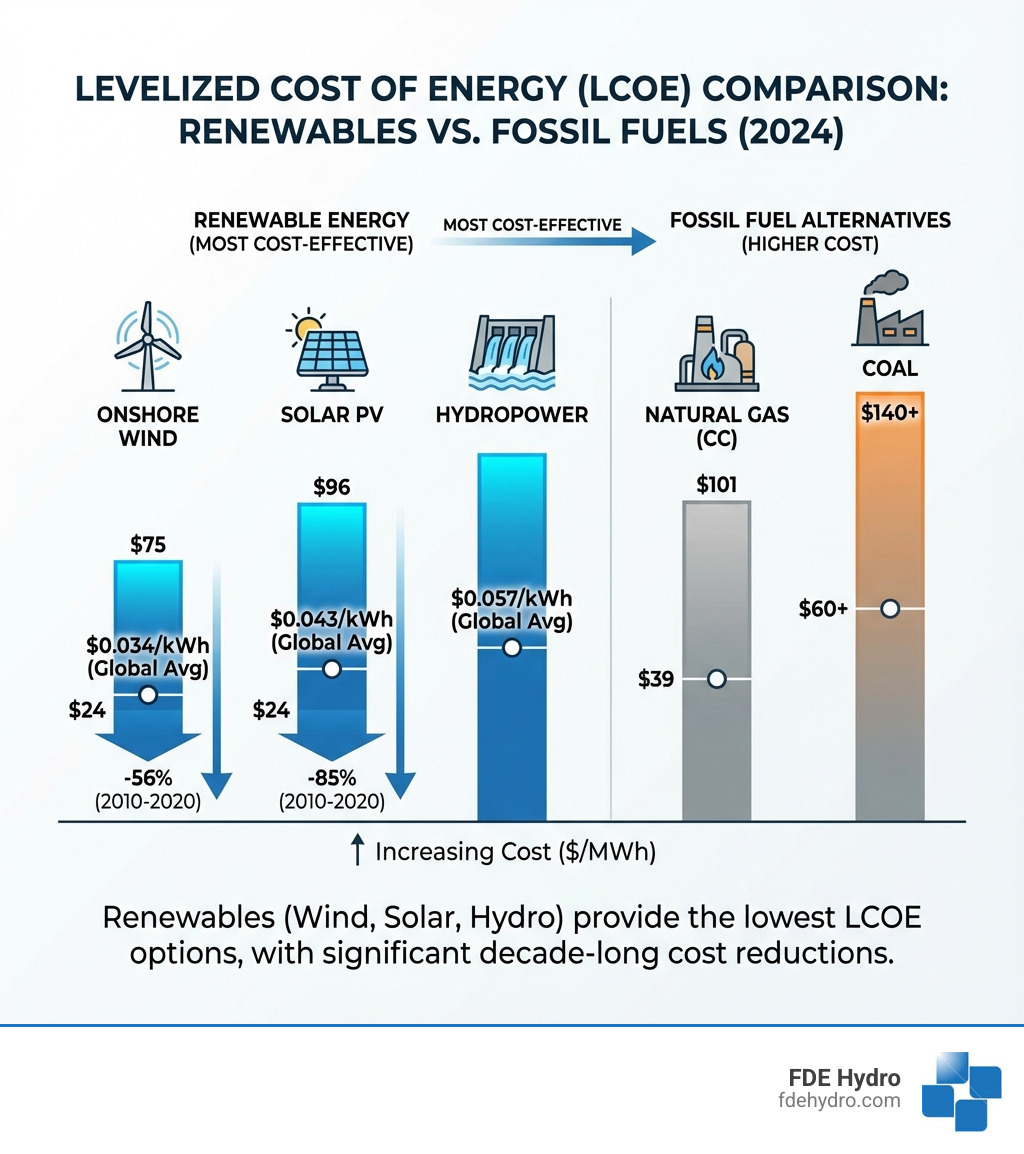
- Onshore Wind – $0.034/kWh (global weighted average LCOE)
- Solar PV – $0.043/kWh (global weighted average LCOE)
- Hydropower – $0.057/kWh (global weighted average LCOE)
For readers new to the concept of Levelized Cost of Energy, the LCOE overview on Wikipedia provides a useful primer on how these costs are calculated and compared across technologies.
Key Finding: In 2024, 91% of newly commissioned utility-scale renewable projects delivered electricity at a lower cost than the cheapest new fossil fuel alternative.
This isn’t just about environmental benefits anymore. It’s about hard economics. The cost to build utility-scale solar farms now ranges from $24 to $96 per megawatt hour, while onshore wind projects cost between $24 and $75 per megawatt hour. Both undercut combined cycle natural gas plants, which range from $39 to $101 per megawatt hour.
For project managers overseeing large-scale infrastructure, these numbers represent a fundamental shift. Renewable energy is now the financially viable choice, not just the environmentally responsible one.
The decade from 2010 to 2020 saw solar photovoltaic costs plunge 85%, while onshore wind costs fell 56%. These aren’t marginal improvements—they’re transformative changes that make renewable energy the default economic choice for new capacity.
But understanding cost-effectiveness requires looking beyond simple price tags. You need to consider total system costs, regional variations, grid integration challenges, and the role of enabling technologies like energy storage.
I’m Bill French Sr., Founder and CEO of FDE Hydro, and I’ve spent decades working on energy infrastructure projects, including serving on the Department of Energy’s Hydro Power Vision Task Force to define next-generation solutions for the most cost effective renewable energy. Through this experience, I’ve seen how innovation in construction methods and technology can dramatically reduce costs while accelerating deployment timelines.
Find more about most cost effective renewable energy:
The Tipping Point: Renewables Outcompete Fossil Fuels on Cost
For years, the narrative around renewable energy often focused on its environmental benefits, with cost-effectiveness frequently seen as a distant goal requiring significant subsidies. Today, that narrative has flipped. Our analysis, supported by leading industry reports, clearly shows that renewable power, particularly solar and onshore wind, is not only competitive but often the most cost effective renewable energy source available, even without government financial support.
Lazard’s 2023 analysis of unsubsidized Levelized Cost of Energy (LCOE) in the U.S. offers compelling evidence. It found that both onshore wind and utility-scale solar photovoltaic (PV) technologies are more cost-effective than combined cycle natural gas power plants. Specifically, utility-scale solar projects registered an LCOE ranging from $24 to $96 per megawatt-hour (MWh), while onshore wind projects came in between $24 and $75/MWh. Compare this to combined cycle natural gas, which ranged from $39 to $101/MWh. This data confirms that for new power generation capacity in the United States, renewables are often the cheapest and quickest option to deploy.
Globally, the trend is even more pronounced. In 2024, onshore wind retained its position as the most affordable source of new power generation, with a global weighted average LCOE of USD 0.034/kWh. Solar PV followed closely at USD 0.043/kWh, and hydropower, a foundational renewable source, at USD 0.057/kWh. This widespread cost advantage means that 91% of all newly commissioned utility-scale renewable projects in 2024 delivered electricity at a lower cost than the cheapest new fossil fuel alternative. This is a monumental shift that underscores the economic viability of a renewable-powered future.
At FDE Hydro, we’ve always understood the importance of economic efficiency in energy projects. Our commitment to developing innovative solutions for clean energy infrastructure aligns perfectly with these trends, ensuring that the projects we undertake contribute to the overall cost-effectiveness of the renewable energy landscape.

Cost of New Power Plants: A Clear Winner
When we look at the cost of building new electricity generation facilities, the competitive edge of renewables becomes remarkably clear. As noted, utility-scale solar farms in the U.S. can be built for $38 to $78 per MWh, and onshore wind projects for $37 to $86 per MWh. These figures stand in stark contrast to the $48 to $109 per MWh for a new combined-cycle natural gas plant. This isn’t just about initial construction costs; it’s about the lifetime cost of electricity production, where renewables consistently prove to be the more economical choice.
The ability of renewables to be deployed quickly further improves their cost-effectiveness. Fewer delays mean faster returns on investment and a quicker path to providing clean power to the grid. While hydropower projects, particularly large-scale ones, have traditionally had higher upfront costs, our advancements at FDE Hydro, through patented modular precast concrete technology, are significantly reducing both construction time and hydropower project costs in regions like North America, Brazil, and Europe. This makes hydropower an increasingly competitive option, especially given its reliability and longevity.
The numbers don’t lie: renewable power, particularly solar and onshore wind, represents the most cost effective renewable energy for new capacity additions.
Competing with Existing Fossil Fuel Plants
Perhaps even more astonishing is that new renewable energy projects are increasingly competitive with, and in many cases cheaper than, simply operating existing fossil fuel plants. While an existing gas plant might have a cost range of $24 to $39 per MWh, and an existing coal plant $31 to $114 per MWh, the global data indicates that new utility-scale solar PV and onshore wind projects can be built and operated at a lower cost than the operating expenses of a significant portion of existing coal-fired capacity.
For instance, IRENA analysis suggests that 800 GW of existing coal-fired capacity globally has operating costs higher than new utility-scale solar PV and onshore wind, even when accounting for integration costs. Replacing these older, more expensive, and polluting plants with new renewables could cut annual system costs by USD 32 billion globally and drastically reduce CO2 emissions.
This economic reality provides a compelling incentive to accelerate the transition away from fossil fuels. It means that retiring costly coal plants is not just an environmental imperative, but a sound financial decision that can lead to significant savings for electricity consumers and utilities alike. Our work in sustainable power generation focuses on facilitating this transition, particularly through the revitalization and expansion of hydropower, which offers a stable and reliable complement to intermittent renewables.
What’s Driving the Green Price Drop?
The remarkable decline in renewable energy costs isn’t a fluke; it’s the result of a confluence of powerful factors. We’ve seen a virtuous cycle of technological innovation, economies of scale, improvements in supply chains, and accumulated developer experience that has continually driven prices down.
Technological innovation has been at the forefront. For solar PV, this means increasingly efficient panels that convert more sunlight into electricity, even in less-than-ideal conditions. For wind, it’s larger, more efficient turbines designed to capture more energy from varying wind speeds. These advancements translate directly into higher energy output per installed unit, lowering the LCOE.
Economies of scale play a massive role. As demand for renewable energy technologies has surged globally, manufacturing processes have become highly optimized, leading to mass production and lower unit costs. The sheer volume of solar panels and wind turbines now produced means that components are cheaper to source and assemble.
Improvements in the global supply chain, though sometimes challenged by geopolitical events, have also contributed to cost reductions. More efficient logistics, specialized machinery, and streamlined installation practices mean projects can be completed faster and with fewer resources. Finally, developer experience – the “learning by doing” effect – means that each new project benefits from the lessons learned on previous ones, optimizing site selection, project design, and operational efficiency. This combination of factors ensures that the most cost effective renewable energy sources continue to become even more affordable.
A Decade of Dramatic Cost Reductions
The past decade has been nothing short of for renewable energy costs. Solar photovoltaic (PV) power, for example, saw its cost per kWh drop by an astonishing 85% from $0.381/kWh to $0.057/kWh. This dramatic reduction has made solar PV one of the most competitive energy sources globally. Onshore wind projects, already cost-effective from the outset, saw their costs fall by 56%, from $0.089/kWh to $0.039/kWh, solidifying their position as a leading source of cheap electricity.
While solar and wind have dominated the headlines for their rapid cost declines, other renewables have also seen significant advancements. Hydropower, often overlooked in discussions of new capacity, benefits immensely from continuous innovation. At FDE Hydro, our patented modular precast concrete technology, often referred to as the “French Dam,” is designed to drastically reduce construction time and costs for new hydroelectric dams and for retrofitting existing water infrastructure in North America, Brazil, and Europe. This approach leverages advanced manufacturing techniques to deliver high-quality, durable structures more efficiently, making hydropower an even more attractive and sustainable power generation option.
The steady decline in LCOEs for renewables across the board is a testament to human ingenuity and market forces. This relentless pursuit of efficiency and affordability is a key driver in making clean energy not just an environmental choice, but an economic imperative. Our focus on clean energy infrastructure ensures we’re part of this ongoing evolution, bringing innovative and cost-effective solutions to the forefront.
The Role of Policy and Incentives
Government policies and incentives have played a crucial, though sometimes debated, role in accelerating the cost-effectiveness and widespread adoption of renewable energy. While renewables are now competitive even without subsidies, strategic policies have historically de-risked investments, stimulated research and development, and helped scale nascent technologies.
In the United States, the Inflation Reduction Act (IRA) stands as a landmark piece of legislation, injecting $161 billion in clean electricity tax credits. These tax credits significantly bolster the financial attractiveness of renewable energy projects, including solar, wind, and storage, making them even more competitive against traditional fossil fuel sources. Such policies provide investment certainty, encouraging developers and investors to commit capital to large-scale renewable projects.
Beyond direct financial incentives, consistent regulatory frameworks, long-term clean energy targets, and streamlined permitting processes also contribute significantly to reducing project risks and, by extension, costs. When policies provide a clear roadmap for the future, it fosters a stable environment for innovation and investment, ensuring the continued growth of the most cost effective renewable energy technologies. Our Renewable Energy Projects Complete Guide highlights how understanding and leveraging these policy landscapes is critical for successful project development.
The Most Cost Effective Renewable Energy: Problems and Solutions
While the economic case for renewable energy is stronger than ever, its widespread adoption isn’t without challenges. The very nature of intermittent sources like solar and wind introduces complexities related to grid integration and reliability. The sun doesn’t always shine, and the wind doesn’t always blow, requiring solutions to ensure a stable and consistent power supply. This is where energy storage plays a pivotal role. Furthermore, administrative problems like permitting delays can significantly slow down the deployment of even the most cost-effective projects.
Understanding the Limits of LCOE
When we talk about the cost-effectiveness of energy sources, the Levelized Cost of Energy (LCOE) is a critical metric. LCOE estimates the average cost of electricity generated by a power plant over its lifetime, accounting for all capital costs, operating and maintenance costs, fuel costs, and financing. However, it’s important to understand its limitations.
Critics, including analysts at J.P. Morgan and academics at the Massachusetts Institute of Technology, argue that LCOE, while useful, can be an inadequate tool for comparing intermittent renewables with dispatchable technologies (like hydropower or natural gas). This is because traditional LCOE doesn’t fully account for “system-wide costs,” such as the need for backup power or grid upgrades to manage the variability of solar and wind. These “intermittency costs” can add a layer of complexity not captured by a simple LCOE calculation.
To address this, more sophisticated metrics and analyses, like Lazard’s LCOE+ report, now include the costs associated with providing backup power for intermittent renewables and short-duration storage batteries. This more comprehensive approach gives us a clearer picture of the true system cost of integrating renewables. Our FDE Hydro’s perspective on LCOE digs deeper into these nuances, emphasizing the importance of considering a holistic view of energy system costs.
The Crucial Role of Energy Storage
Energy storage is not merely an add-on; it’s a fundamental enabler for the widespread deployment and cost-effectiveness of intermittent renewable energy. By storing excess power generated during peak production times (e.g., sunny afternoons for solar, windy nights for wind) and releasing it when demand is high or generation is low, storage solutions ensure grid stability and reliability.
The good news is that Battery Energy Storage Systems (BESS) have seen dramatic cost declines, mirroring the trajectory of solar PV. The total installed cost of utility-scale BESS plummeted by 93% between 2010 and 2024, reaching an impressive USD 192/kWh. This makes battery storage an increasingly viable option for short-to-medium duration storage needs.
However, for long-duration energy storage (LDES), capable of providing power for many hours or even days, other technologies come into play. These include:
- Mechanical Storage: This category includes well-established technologies like Pumped Storage Hydropower, which currently accounts for a staggering 96% of all utility-scale energy storage in the United States. Other mechanical options include gravity-based systems and compressed air energy storage.
- Thermal Storage: Storing energy as heat or cold.
- Chemical Storage: Technologies like hydrogen production and fuel cells.
- Electrochemical Storage: Advanced battery chemistries beyond lithium-ion, designed for longer durations.
Pumped storage hydropower, in particular, is a game-changer for grid stability, offering large-scale, long-duration storage that can respond rapidly to grid needs. At FDE Hydro, we recognize the immense value of hydropower, both for generation and storage, and our innovations aim to make these vital assets even more efficient and affordable. Investing in diverse storage solutions is key to open uping the full potential of the most cost effective renewable energy sources.
Overcoming Grid and Permitting Bottlenecks
Even with the declining costs of renewable technologies and the advancements in storage, significant barriers can hinder the deployment of the most cost effective renewable energy projects. One of the most pressing challenges in the United States is the growing backlog in interconnection queues. These are essentially waiting lists for new energy projects to connect to the electricity grid.
The numbers are stark: generation capacity entering these queues increased by over 550% from 2015 to 2023, and the average queue duration has stretched from 3 years to 5 years. Alarmingly, only 19% of applications in these queues ultimately reach commercial operations, with many projects withdrawing due to prolonged delays and escalating costs. Wind projects, for instance, face an average queue duration of 40 months, while solar projects average 34 months. In states like California and New York, where renewable energy targets are ambitious, these delays can significantly impede progress.
These bottlenecks are not just administrative nuisances; they represent tangible costs and missed opportunities. They delay the availability of clean, affordable power and slow down our transition away from fossil fuels. To mitigate this growing backlog, the U.S. Department of Energy suggests enhancing data transparency, streamlining approval processes, promoting economic efficiency, and maintaining a reliable grid.
At FDE Hydro, we understand that efficient project development is crucial. Our FDE Hydro’s insights on project development emphasize the importance of innovative construction methods, like our modular approach, which can help accelerate the physical construction phase, potentially reducing overall project timelines once permitting is secured. Addressing these grid and permitting challenges is paramount to fully realizing the benefits of cost-effective renewable energy.
Future Outlook: A Diverse and Cost-Effective Energy Mix
Looking ahead, the outlook for renewable energy is overwhelmingly positive. While the dramatic cost reductions of the past decade may begin to stabilize as technologies mature, renewables are projected to maintain their strong competitiveness. The future energy mix will likely be characterized by diversity, leveraging the strengths of various renewable sources, complemented by advanced storage and smart grid technologies. This evolution will further cement the position of most cost effective renewable energy solutions in our power infrastructure.
Our FDE Hydro’s vision for energy infrastructure emphasizes a holistic approach, where innovation in construction and technology plays a key role in building a resilient, sustainable, and affordable energy future.
Identifying the Most Cost Effective Renewable Energy by Region
The “most cost effective” renewable energy isn’t a one-size-fits-all answer; it varies significantly by region, primarily due to differences in resource availability, market conditions, and financing costs.
- Solar Power: In sunny regions like California and the U.S. Southwest, solar PV is often the frontrunner for cost-effectiveness. Its abundance of sunshine makes it an ideal location for utility-scale solar farms.
- Wind Power: States in the U.S. Midwest, as well as parts of Canada and Europe, boast excellent wind resources, making onshore wind projects exceptionally competitive. Kansas, for example, is known for its strong winds, making it a prime location for wind energy development.
- Hydropower: Regions with abundant water resources and suitable topography, such as many areas in Canada, Brazil, and parts of the United States (like New York) and Europe, find hydropower to be a highly efficient and reliable option. Hydropower’s ability to provide consistent baseload power and rapid response makes it invaluable.
Financing costs also play a significant role. Stable regulatory environments and mature markets, such as those in the U.S. and Europe, often benefit from lower costs of capital compared to emerging markets, further enhancing the cost-effectiveness of renewable projects. Understanding these regional nuances is crucial for identifying the truly most efficient renewable energy resource for any given location.
Hydropower: The Untapped Baseload Powerhouse
Amidst the excitement around solar and wind, hydropower often flies under the radar, yet it remains a quietly powerful and incredibly cost-effective renewable energy source, particularly for providing baseload power and critical grid reliability. Globally, hydropower still provides more electricity capacity than any other renewable energy source, and its ability to store energy (as in pumped hydro) makes it a natural complement to intermittent renewables.
In the United States, there’s a massive untapped potential. Of the more than 80,000 dams across the country, less than 10% are currently used for electricity generation. This represents an enormous opportunity to expand our clean energy capacity without building new dams from scratch. Retrofitting existing non-powered dams with modern hydropower technology is a highly cost-effective way to add renewable generation to the grid.
At FDE Hydro, we are at the forefront of this revitalization. Our patented modular precast concrete technology, the “French Dam,” drastically reduces the construction time and hydropower project costs for both new installations and the crucial retrofitting of existing dams. This innovation is particularly impactful in North America, Brazil, and Europe, where our technology makes hydropower projects more economically viable and accelerates their deployment. Our work directly contributes to making hydropower a leading contender for the most cost effective renewable energy solutions. We believe that with hydropower advancements & innovations 2025, this sector will play an even greater role in our energy future.
Projections for the Most Cost Effective Renewable Energy
The future for the most cost effective renewable energy looks bright, characterized by continued growth and increasing integration. While the era of steep, year-on-year cost declines may be moderating as technologies mature, the competitiveness of solar and wind against fossil fuels is firmly established. Globally, solar PV is expected to see its total installed costs fall below USD 600/kW by 2026, while onshore wind costs are projected to stabilize between USD 850 and 1,000/kW. These stabilizing prices indicate a mature market that continues to offer highly attractive investment opportunities.
The global energy system is undergoing a profound change. In 2024, global renewable power capacity additions reached an unprecedented 582 GW, a nearly 20% increase over the previous year. This record growth, driven by technological innovation, competitive supply chains, and economies of scale, highlights the sustained momentum towards renewables.
For us, this means a future where increased renewable energy capacity and investment become the norm, not the exception. The transition away from fossil fuels is not just an aspiration but an economic reality, with renewables being the default choice for new power generation. Our commitment to innovation in hydropower, as detailed in our exploration of the future of hydropower, positions us to contribute significantly to this evolving, diverse, and cost-effective energy mix.
Conclusion: The Economic Case for a Renewable Future is Clear
In summary, the journey of renewable energy from niche, environmentally conscious choice to the most cost effective renewable energy option has been swift and decisive. Solar PV, onshore wind, and hydropower now consistently undercut fossil fuels in terms of new build costs, and often even compete favorably with the operating costs of existing conventional plants. This remarkable shift has been driven by relentless technological innovation, economies of scale, and supportive policy frameworks.
However, the path to a fully renewable grid is not without its problems. Challenges like grid integration, intermittency, and permitting bottlenecks require strategic solutions, with energy storage, particularly pumped storage hydropower, playing a crucial role. Our understanding of the Levelized Cost of Energy (LCOE) must evolve to include system-wide costs, ensuring a comprehensive view of true cost-effectiveness.
At FDE Hydro, we believe that innovation, especially in construction methodologies, is key to overcoming these challenges. Our patented modular construction techniques for hydropower projects are designed to reduce costs and accelerate deployment, making this reliable baseload renewable even more competitive. The economic case for a renewable future is no longer a debate; it’s a clear, compelling reality.
We are proud to be part of this energy revolution, offering solutions that make renewable energy more accessible and affordable. Learn more about the pivotal role of hydropower in building a sustainable energy future.
