

Why Clean Energy Construction is Critical for Canada’s Future

Clean energy construction is the process of building the physical infrastructure needed to generate, store, and distribute renewable power—from wind farms and solar arrays to hydroelectric facilities and battery storage systems. It encompasses everything from site preparation and component manufacturing to installation, grid connection, and the retrofit of existing buildings. Here’s what you need to know:
- Scale of Opportunity: Canada’s clean energy sector supported 1.4 million jobs in 2024, with clean energy construction representing one of the fastest-growing employment categories.
- Key Infrastructure Types: Wind turbines, solar photovoltaic (PV) systems, battery energy storage, hydropower plants, and grid modernization projects like EV charging stations.
- Economic Impact: Over $80 billion was invested in clean power in 2024 alone, with the green retrofit sector expected to create 777,000 to 2 million direct job years by 2050.
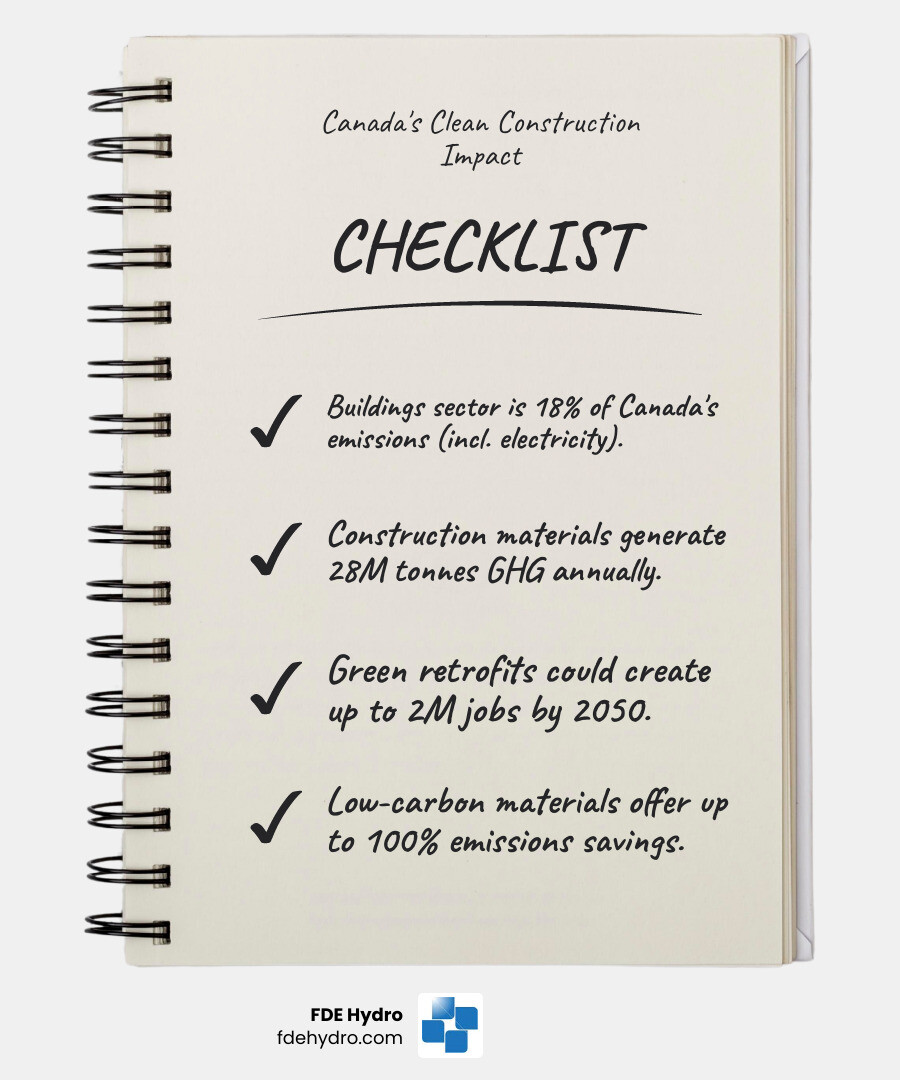
- Emissions Reduction: Buildings account for 18% of Canada’s emissions when including electricity. Construction materials for public infrastructure generate approximately 8 million tonnes of greenhouse gases annually—28 million tonnes when private construction is included.
- Low-Carbon Materials: Material emissions savings of up to 32% for concrete, 100% for structural steel, and 98% for insulation can be achieved at no or negligible cost increases.
Canada’s buildings are the third largest emitting sector, and the production of construction materials alone contributes significantly to our carbon footprint. But here’s the good news: the construction and installation phase of renewable energy projects is where innovation meets opportunity. New manufacturing facilities, advanced modular construction techniques, and Buy Clean policies are changing how we build.
Over 96% of direct operational building emissions come from space and water heating, mostly from fossil fuel equipment. That means the infrastructure we build today—the wind turbines, solar farms, energy storage systems, and deep retrofits—will determine whether we meet our net-zero goals by 2050. Between 2000 and 2021, heat pump installations in Canadian homes increased by 110%. That’s just the beginning.
I’m Bill French Sr., Founder and CEO of FDE Hydro, where we’ve pioneered modular precast concrete solutions for hydropower facilities across North America, Brazil, and Europe. With decades of experience in heavy civil construction and site development, I’ve seen how innovative clean energy construction methods can dramatically reduce project timelines, costs, and environmental impacts while powering a sustainable future.
Quick Clean energy construction terms:
The Blueprint for a Greener Canada: Major Types of Clean Energy Infrastructure
When we talk about clean energy construction in Canada, we’re building the very backbone of our sustainable future. This isn’t just about putting up solar panels; it’s about creating a comprehensive energy ecosystem. The main types of clean energy infrastructure currently being constructed in Canada, and across our operating regions in North America, Brazil, and Europe, primarily include wind energy, solar energy, energy storage facilities, and critically, hydropower. These projects are often interconnected, leveraging synergies to maximize efficiency and contribute significantly to our emissions reduction goals.
Beyond generation and storage, we’re also seeing substantial development in smart grids and electric vehicle (EV) charging stations. These are vital for distributing the clean energy we produce and enabling the electrification of our transportation sector. The construction of this diverse infrastructure works together to strengthen our grid, improve reliability, and accelerate the transition away from fossil fuels. For a deeper dive into these systems, explore our page on Clean Energy Infrastructure.
Main Types of Clean Energy Projects
Let’s break down the primary types of clean energy projects we’re seeing take shape:
- Wind Energy: This involves the construction of large onshore wind farms, featuring turbines that can reach impressive sizes, with components often exceeding the length of a football field during transport. Canadian construction teams are adept at building some of the world’s largest onshore wind turbines.
- Solar Energy: We’re installing advanced solar photovoltaic (PV) technology in large arrays that are linked together to power entire communities. From utility-scale farms to commercial rooftop installations, solar PV construction is expanding rapidly.
- Energy Storage Facilities: New battery energy storage systems (BESS) are being deployed in various locations, often co-located with wind and solar generators, to store excess energy and release it when demand is high or generation is low. This helps overcome the intermittency challenges of some renewables.
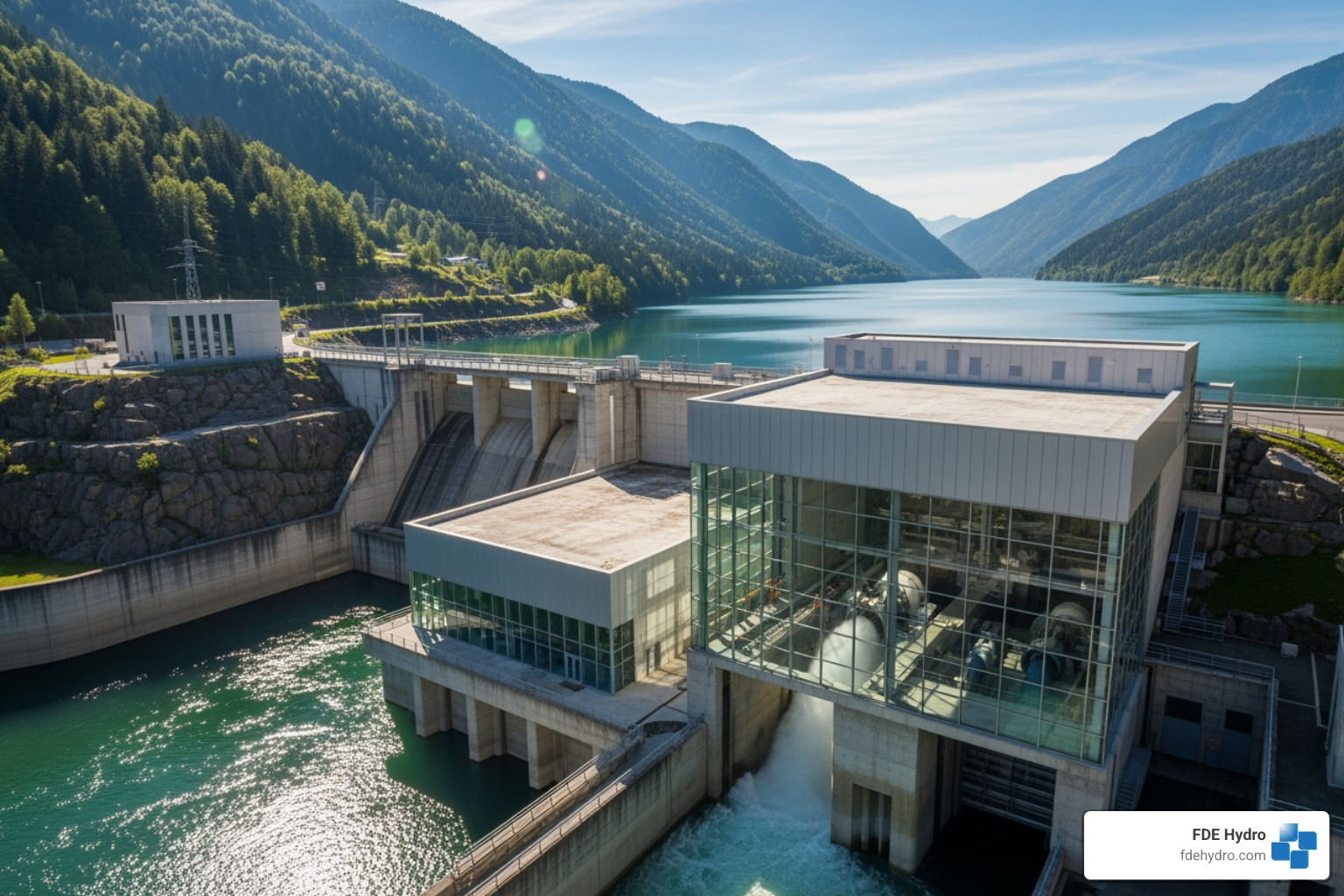
- Hydropower: As specialists in this field, we at FDE Hydro focus on building and retrofitting hydroelectric dams and water control systems, including run-of-river plants, reservoir plants, and pumped storage plants. Hydropower offers reliable, stable, and flexible power generation, crucial for balancing the grid. You can learn more about Sustainable Power Generation through these methods.
- Grid Modernization Initiatives: This includes the development of smart grids, which use digital technology to monitor and manage the transport of electricity, and the expansion of EV charging stations, which are essential for supporting the growing fleet of electric vehicles.
The synergies between wind, solar, and energy storage technologies during the clean energy construction phase are becoming increasingly important. For example, co-locating solar and battery storage can optimize land use and grid connection points. Similarly, hydropower can complement intermittent sources by providing baseload power or rapid response generation. Smart grids, in particular, leverage these new wind, solar, and energy storage technologies by efficiently integrating them into the existing power system, ensuring stability and reliability as the grid becomes more decentralized and dynamic.
Successful Canadian Project Examples
Canada has a growing portfolio of successful clean energy construction projects that showcase our commitment to a greener future:
- Hydropower Innovations: At FDE Hydro, we’ve been involved in numerous projects across North America, Brazil, and Europe, utilizing our patented modular precast concrete technology to build and retrofit hydroelectric dams. This “French Dam” technology significantly reduces construction costs and timelines, making sustainable hydropower more accessible and efficient. An example would be the Peribonka Generating Station, which featured a deep cutoff wall 110 meters below the dam, showcasing complex engineering in hydropower construction.
- Green Building Retrofits: The Ken Soble Tower Project in Hamilton, Ontario, is a prime example of a deep energy retrofit. It transformed an aging social housing high-rise into the first Passive House tower in Canada, dramatically improving energy efficiency and livability. The Gordon Bell High School project in Winnipeg also aimed to cut energy use by 51% through deep retrofits.
- Innovative New Builds: Vancouver’s Brock Commons Tall Wood House, an 18-storey building, demonstrated innovative wood-based solutions for high-rise construction, significantly reducing embodied carbon. The YWCA Courtyard Project in Banff, an affordable housing building constructed from recycled shipping containers, aimed for net-zero energy efficiency.
- Community Resilience: The Millbrook First Nation Resilience Centre in Nova Scotia is registered under the Canada Green Building Council’s Zero Carbon Design Standard, providing essential services while minimizing environmental impact. For more on Canada’s green building industry, check out More on Canada’s green building industry.
- Modular and Prefabricated Solutions: The Saskatchewan Prefab Pilot, featuring net-zero energy rental units built with prefabricated panels, showcases how modular construction can accelerate the deployment of sustainable and affordable housing.
The Nuts and Bolts of Clean Energy Construction
The journey from a clean energy concept to a fully operational facility is a complex one, involving intricate project lifecycles, a highly skilled workforce, robust supply chain logistics, stringent safety standards, and adherence to regulatory compliance. Each phase of clean energy construction demands precision and expertise to ensure projects are completed efficiently, safely, and to the highest environmental standards. For a comprehensive overview, our Renewable Energy Projects Complete Guide offers valuable insights.
Key Stages and Challenges
The construction and installation of wind, solar, and energy storage projects typically follow several key stages, each with its own set of challenges:
- Site Selection and Preparation: Identifying optimal locations for resource availability (wind, sun, water), grid access, and minimal environmental impact. Challenges include land acquisition, environmental assessments, and preparing remote or difficult terrains.
- Permitting and Contracts: Navigating complex regulatory frameworks, securing environmental approvals, and establishing power purchase agreements. This stage can be lengthy and fraught with legal and community engagement challenges.
- Foundation and Civil Works: This is where the heavy lifting begins, including site grading, access road construction, and laying deep foundations for wind turbines or constructing the structural elements of hydroelectric dams and energy storage facilities. For FDE Hydro, this is our bread and butter, where our modular precast concrete solutions shine in reducing complexity and time.
- Component Transportation: Moving massive components like wind turbine blades (which can exceed the length of a football field) or large solar panels and battery modules to often remote sites requires specialized logistical expertise and careful planning.
- Installation and Commissioning: Erecting turbines, mounting solar panels, installing battery racks, and connecting all electrical systems. This phase demands highly skilled crews and technical specialists.
- Grid Connection: Integrating the new energy source into the existing electrical grid, which involves building new transmission lines, substations, and ensuring grid stability. This can be particularly challenging for large-scale projects in areas with limited existing infrastructure.
Common challenges we face include:
- Logistical Complexity: Transporting oversized components to remote sites.
- Permitting Problems: Navigating diverse and evolving regulatory landscapes.
- Technical Expertise: The need for highly specialized skills for installation and integration.
- Environmental Considerations: Minimizing ecological impact during construction.
- Financing and Investment: Securing the significant capital required for large-scale projects.
The Role of Skilled Crews and the Supply Chain
Skilled construction crews and technical specialists are the unsung heroes of clean energy construction. They are the ones on the ground, bringing these ambitious projects to life. From engineers and electricians to heavy equipment operators and specialized technicians, their expertise is indispensable. We need HVAC tradespeople, electricians, and more, with RBC estimating a 45% increase in HVAC tradespeople and a 55% increase in electricians needed by 2030 in Canada. The importance of tradespeople in the building sector cannot be overstated.
Canada’s supply chain plays a critical role in supporting these projects. Many high-quality renewable energy components are made right here in Canada, supporting domestic industries and creating jobs. This includes everything from the raw materials for solar panels and battery components to the manufactured parts of wind turbines and, in our case, the specialized precast concrete elements for hydropower.
The logistical expertise required to manage these supply chains, both domestically and internationally, is immense. It ensures that components arrive on time, safely, and efficiently. Prioritizing safety in all construction and installation activities is paramount, with strict safety protocols and regulatory standards in place to protect workers and the environment. Matching and exceeding these standards is a best practice across the industry. For more on the importance of these roles, refer to The importance of tradespeople in the building sector.
Building Smarter: Materials and Innovations Driving Efficiency
Innovation is at the heart of clean energy construction, not just in the technologies we deploy, but in how we build them. This includes a strong focus on low-carbon materials and advanced construction methods that improve efficiency, reduce environmental impact, and scale up project delivery. At FDE Hydro, our modular precast concrete technology is a prime example of how innovations contribute to the efficiency and scale of renewable energy projects by significantly cutting down construction time and costs. Explore how we approach Modular Construction Techniques in our work.
The ‘Buy Clean’ Movement and Low-Carbon Materials
The “Buy Clean” movement is gaining significant traction in Canada and globally. This policy approach leverages federal procurement and investment to promote the use of low or net-zero-carbon construction materials and designs. Essentially, it means choosing building materials that have a lower “embodied carbon.”
Embodied carbon refers to the greenhouse gas emissions generated during the manufacture, transport, and construction of building materials, as well as their end-of-life emissions. This is distinct from operational carbon, which comes from a building’s day-to-day energy use. The production, transport, and demolition of construction materials used in public infrastructure alone account for approximately 8 million tonnes of greenhouse gas emissions annually in Canada, a figure that jumps to around 28 million tonnes when private construction is included.
Canada’s government is implementing a Buy Clean approach in federal procurement, requiring a 30% reduction of embodied carbon in major construction projects starting in 2025. This policy encourages the use of materials like:
- Low-carbon concrete: Innovations in concrete mixes can significantly reduce its carbon footprint. Our modular precast concrete solutions, for instance, can be designed with these considerations in mind, contributing to lower embodied carbon in hydropower projects. Learn more about Precast Concrete Technology.
- Mass timber: A renewable resource that sequesters carbon.
- Recycled steel: Reduces the energy-intensive process of new steel production.
The good news is that building with lower-carbon materials doesn’t necessarily mean higher costs. Material emissions savings of up to 32% for concrete, 100% for structural steel, 53% for rebar, 55% for drywall, and 98% for insulation have been identified at no or negligible cost increases. This makes the Buy Clean approach not just an environmental imperative, but an economic opportunity for Canadian industries to develop and supply these materials. You can find more Details on Canada’s Buy Clean approach.
Innovations in Clean Energy Construction Methods
Beyond materials, innovations in construction methods themselves are changing the landscape of clean energy projects:
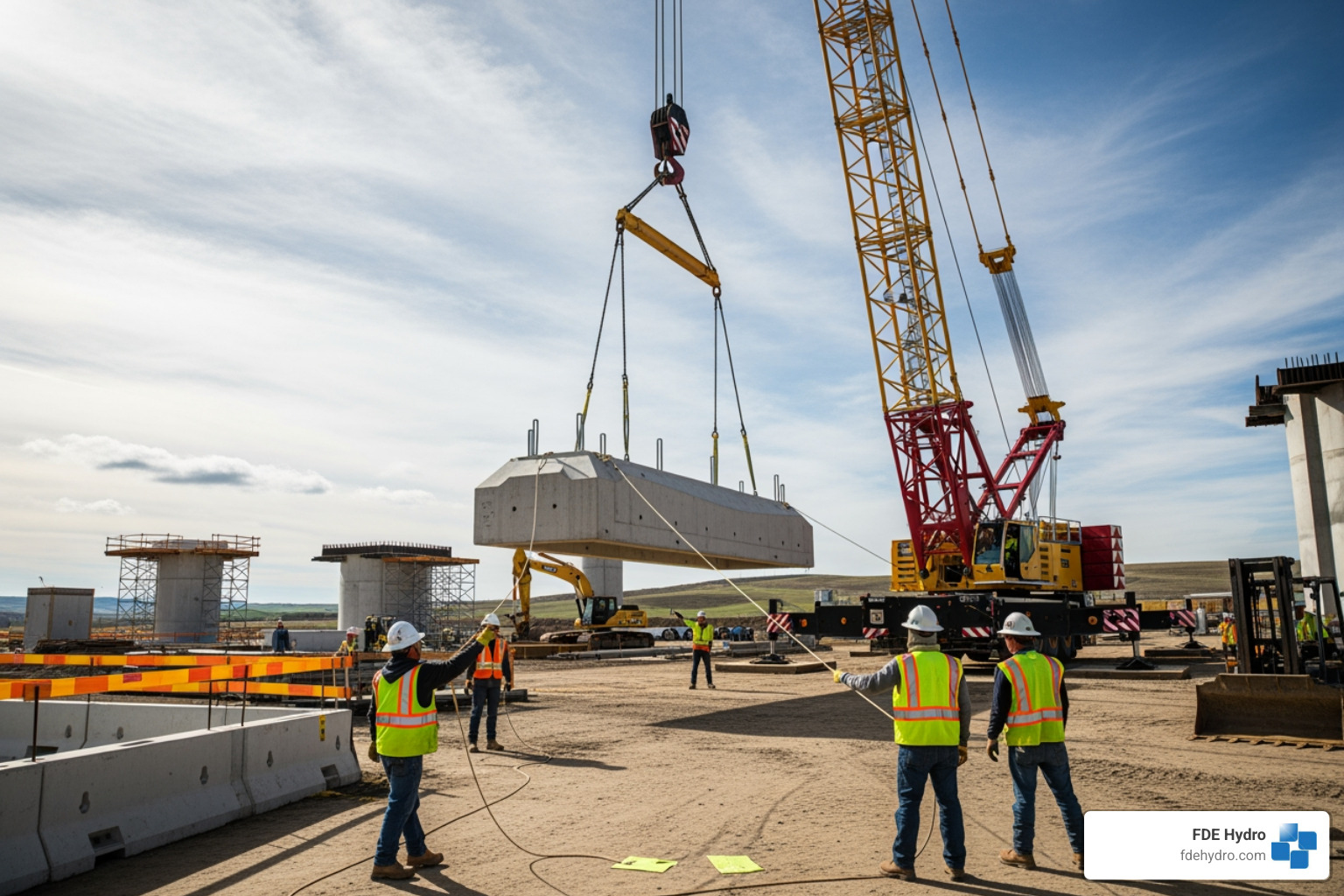
- Prefabrication and Modularization: This is where FDE Hydro truly shines. Our patented modular precast concrete technology allows for components of dams and water control structures to be manufactured off-site in controlled environments. This not only dramatically reduces on-site construction time and costs but also improves quality, minimizes waste, and improves safety. We’ve seen similar approaches in housing, with projects like the Saskatchewan Prefab Pilot demonstrating net-zero energy rental units built with prefabricated panels, speeding up affordable housing deployment.
- Efficient Building Design: Smart design can significantly reduce both cost and carbon by minimizing the quantity of construction materials needed. This includes optimizing structural elements and layouts to achieve performance goals with fewer resources.
- Next-Gen Manufacturing: Advances in manufacturing processes are leading to more efficient and lower-carbon production of clean energy components, from solar panels to battery cells. This supports the development of a robust domestic supply chain. These innovations are crucial for our Next-Gen Manufacturing Energy Resource.
- Scaling the Deep Retrofit Market: While building new green structures is vital, retrofitting existing buildings is equally, if not more, important. The vast majority of buildings that will be standing in 2050 are already built. The historic pace of retrofits shows it would take 140 years to retrofit all residential buildings and 70 years for all commercial floor area in Canada. Scaling this market means overcoming challenges like upfront costs and a shortage of skilled labor, but offers immense opportunities for job creation (777,000 to 2 million direct job years) and emissions reduction. To learn more, explore Exploring Canada’s deep retrofit market.
The Economic and Policy Backbone of Green Construction
The rapid expansion of clean energy construction in Canada is not happening in a vacuum; it’s strongly supported by government strategies, significant economic opportunities, and a growing demand for skilled labor. This interconnected web of policy and economics forms the crucial backbone for building our sustainable future. Developing robust Sustainable Infrastructure Development is a collective effort.
Government’s Role and Strategy
The Canadian government plays a pivotal role in promoting green building construction and materials through a multi-faceted approach:
- Canada Green Buildings Strategy (CGBS): This overarching strategy aims to transform the buildings sector towards a net-zero and resilient future. Its three strategic priorities are:
- Accelerate Retrofits: Rapidly increasing the rate of energy-efficient, deep, and climate-resilient building retrofits.
- Build Green and Affordable from the Start: Ensuring new homes and buildings are constructed to be low-carbon, energy-efficient, climate-resilient, and affordable.
- Shape the Buildings Sector of the Future: Focusing on decarbonization, particularly the electrification of space and water heating, and developing innovative technologies.
- Greening Government Strategy (GGS): This commits the Government of Canada to achieve net-zero emissions in federal real property operations and implement a “Buy Clean” approach for its own procurement.
- National Building Code and Energy Code: These codes are being continually updated to mandate higher energy performance standards and encourage climate-resilient construction.
- Clean Electricity Regulations (CER): These regulations are crucial for ensuring that the electricity used to power Canada’s increasingly electrified buildings and infrastructure is clean and emissions-free.
- Federal Funding Programs: A suite of programs provides financial incentives and support:
- Canada Greener Homes Grant and Loan programs: Helping homeowners retrofit their homes.
- Deep Retrofit Accelerator Initiative: Accelerating large-scale deep retrofit projects.
- Green and Inclusive Community Buildings (GICB) Program: Supporting green retrofits and new construction of public community buildings.
- Canada Housing Infrastructure Fund and Apartment Construction Loan Program: To accelerate housing construction and upgrades, emphasizing greener practices.
- Canada Greener Affordable Housing Program: Supporting low- to median-income Canadians with energy efficiency upgrades.
These initiatives align with Canada’s National Adaptation Strategy by improving infrastructure resilience against climate impacts. The Clean Electricity Regulations (CER) are fundamental as Canada electrifies its buildings and economy, ensuring the growing demand for electricity is met with clean sources.
Economic Opportunities and Job Creation
Clean energy construction is a powerful engine for economic growth and job creation in Canada:
- Job Growth in Retrofits: The green retrofit sector alone is projected to create between 777,000 and 2 million direct job years between now and 2050. This is a massive opportunity for skilled trades.
- Overall Clean Energy Jobs: Canada’s green buildings industry already employs about 460,000 workers, and Canadian jobs in clean energy are set to grow 7% a year.
- Demand for Skilled Trades: The shift towards electrification and energy-efficient building creates a high demand for specialized skills. For instance, RBC estimates that by 2030, Canada will need 45% more HVAC tradespeople and 55% more electricians. This highlights the crucial need for training and upskilling programs to meet this demand.
- Supporting Domestic Industries: The “Buy Clean” policies and increased demand for low-carbon materials stimulate domestic manufacturing and innovation, strengthening Canada’s position in the global green economy.
- Investment Potential: Decarbonizing Canada’s buildings sector will require more than $400 billion over the next 30 years in capital investment, presenting significant opportunities for businesses and investors. These investments are vital for comprehensive Energy Infrastructure Development Complete Guide.
The construction of energy infrastructure directly contributes to Canada’s overall emissions reduction goals in several ways. By building renewable energy generation (wind, solar, hydro), we replace fossil fuel-based electricity, thus reducing emissions from the power sector. By constructing energy storage facilities, we improve grid stability, allowing for greater integration of intermittent renewables. And through green building construction and deep retrofits, we tackle the operational emissions from buildings, which currently account for 13% of direct emissions (and 18% including electricity-related emissions), largely from fossil fuel-based heating. This comprehensive approach is essential for Canada to meet its net-zero targets.
Frequently Asked Questions about Clean Energy Construction
Does clean energy construction cost more than traditional methods?
No, not necessarily. Innovations in efficient design and the falling cost of low-carbon materials mean that green construction can be cost-competitive. Material savings of up to 32% for concrete and 100% for structural steel have been identified at negligible cost increases. Furthermore, efficient design can reduce both cost and carbon by reducing the quantity of construction materials needed. For example, our modular precast concrete solutions at FDE Hydro are specifically designed to reduce construction costs and time compared to traditional methods for hydropower projects.
What is the difference between embodied carbon and operational carbon?
Operational carbon refers to the emissions from a building’s day-to-day energy use, like heating and lighting. Embodied carbon refers to all the emissions generated from manufacturing, transporting, and installing the building materials themselves. In clean energy construction, we aim to reduce both: operational carbon through energy-efficient designs and renewable energy integration, and embodied carbon through the use of low-carbon materials and efficient construction processes.
What role does retrofitting play in clean construction?
Retrofitting is crucial. With the vast majority of buildings that will exist in 2050 already standing today, deep energy retrofits are essential to reduce the building sector’s overall emissions. Over 96% of direct operational building emissions come from space and water heating, mainly from fossil fuels, making retrofits key to decarbonization. The green retrofit sector is also a major source of job creation, expected to see job growth of 777,000 to 2 million direct job years between now and 2050.
Conclusion: Building a Sustainable Future, One Project at a Time
The journey towards a net-zero future is an ambitious one, but clean energy construction is paving the way. We’ve explored the diverse types of clean energy infrastructure being built in Canada, from wind and solar farms to critical hydropower facilities like those we specialize in at FDE Hydro. We’ve digd into the complex stages and challenges of these projects, highlighting the indispensable role of skilled crews and a robust supply chain.
Innovations in low-carbon materials and construction methods, particularly modularization and prefabrication, are revolutionizing how we build, making projects more efficient, cost-effective, and environmentally friendly. The “Buy Clean” movement is a testament to our commitment to reducing embodied carbon, while scaling the deep retrofit market promises both environmental gains and significant job creation.
Underpinning all this is a supportive policy environment from the Canadian government, coupled with immense economic opportunities and the potential for substantial job growth. The construction of this new energy infrastructure is not just about building physical structures; it’s about building a resilient, sustainable, and prosperous future for Canada.
As we build the future, the foundation must be sustainable, leveraging technologies like advanced Hydropower to secure a cleaner, more resilient energy grid for generations to come. At FDE Hydro, we are proud to contribute to this vital change, bringing our modular precast concrete solutions to North America, Brazil, and Europe, and demonstrating how innovation in clean energy construction can truly power tomorrow.