

Why Modular Precast Is Changing Infrastructure Development
Modular precast is a construction method where concrete building elements are manufactured in a controlled factory environment, then transported to the construction site for rapid assembly. Unlike traditional cast-in-place concrete poured on-site, modular precast offers:
- Faster construction timelines – components arrive ready to install
- Superior quality control – factory conditions ensure consistent, high-strength concrete
- Reduced on-site labor – assembly requires fewer workers than traditional methods
- Improved durability – controlled curing produces more resilient structures
- Cost savings – shorter schedules, less equipment, and earlier building use
The construction industry is under pressure. Infrastructure projects face escalating costs, tight timelines, and mounting risks from weather delays and labor shortages. Traditional cast-in-place concrete construction, while flexible, can’t keep pace with modern demands.
Consider this: data center developers who once accepted nine to 12-month construction schedules are now targeting under four months. Bridge projects that once snarled traffic for years now use prefabricated elements installed over a single weekend. The global forecast shows $6.7 trillion in capital expenditures for data centers and infrastructure over the next five years.
The solution gaining momentum? Modular precast concrete—a method that moves the messy, weather-dependent work of concrete construction from chaotic job sites into climate-controlled factories where precision, speed, and quality reign.
I’m Bill French Sr., Founder and CEO of FDE Hydro™, where we’ve pioneered modular precast applications in hydropower infrastructure, including our patented French Dam technology. My five decades leading major civil construction projects, including the landmark I-93 Fast14 bridge project utilizing modular precast bridge construction, taught me that the future belongs to methods that reduce risk while accelerating delivery.
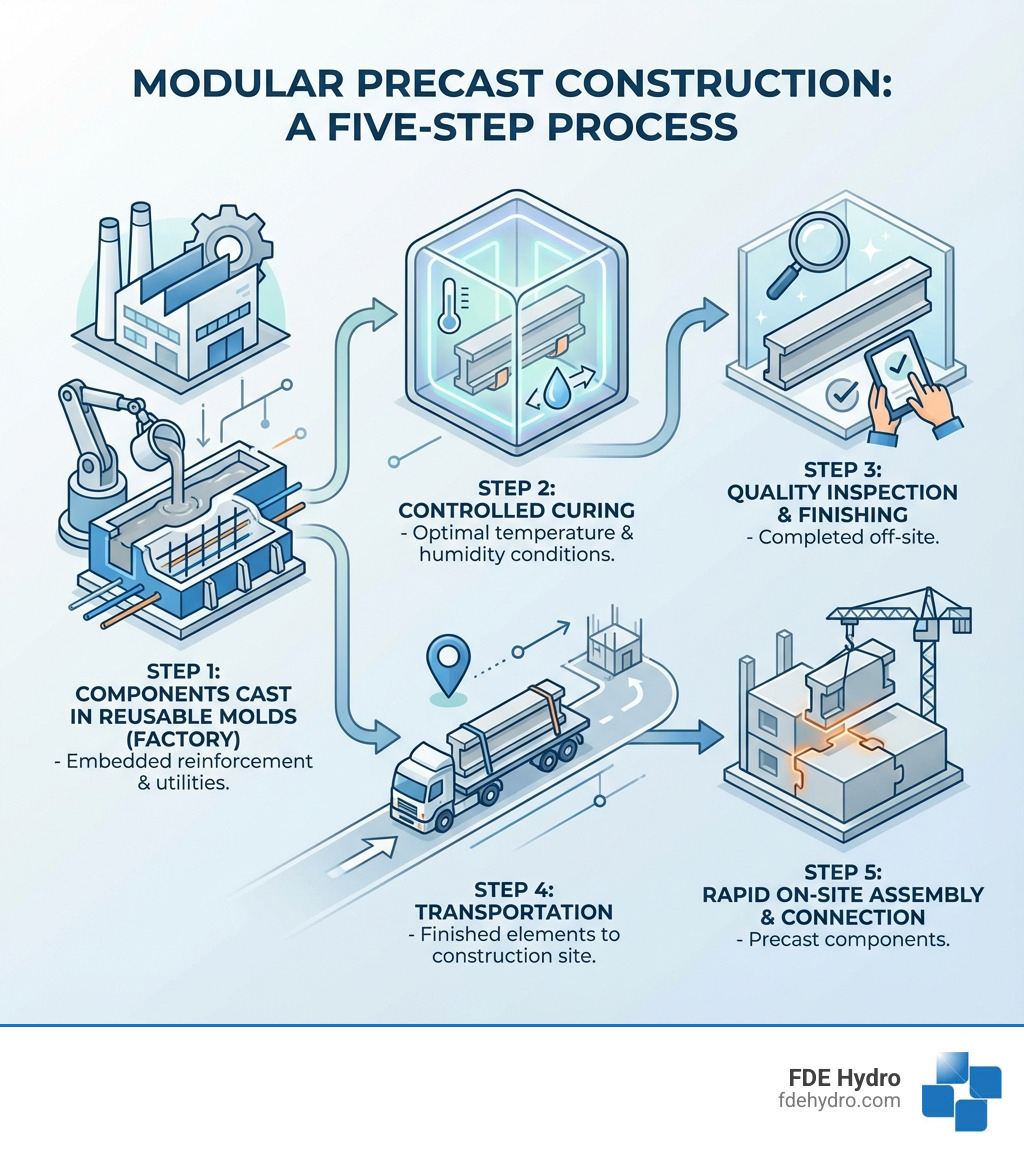
Must-know modular precast terms:
The Core Advantages: Why Build with Modular Precast?
When we talk about modular precast construction, we’re not just discussing a different way to pour concrete; we’re talking about a fundamental shift in how we approach building, emphasizing efficiency, predictability, and long-term value. The benefits extend far beyond the initial construction phase, influencing everything from project timelines and budgets to the structural integrity and environmental footprint of our infrastructure.
Best Speed and Cost-Effectiveness
One of the most compelling reasons to choose modular precast is the sheer speed it brings to a project. Imagine building critical infrastructure components off-site, in parallel with site preparation. This concurrency dramatically shortens project timelines. For instance, some of our clients using modular precast solutions for buildings can have them installed on a level layer of compacted stone in less than an hour, with wall panels and roof slabs erected in a fraction of the time of other methods.
This speed translates directly into significant cost savings. By reducing the time spent on-site, we minimize labor costs, equipment rental fees, and the expenses associated with managing a prolonged construction zone. The precast concrete construction method considers entire costs for the shell, including material savings, lower site equipment costs due to shorter construction time, and earlier building utilization. This concept is beautifully explained in our article Why Precast Cost Less.
Consider the burgeoning data center market. The Canada data center market alone is projected to more than double by 2030 to U$22.24 billion. Globally, a McKinsey report forecasts an astounding $6.7 trillion of capital expenditures associated with data centers and supporting infrastructure over the next five years. The demand for rapid deployment is intense; developers are now targeting not even four months to complete a new data center facility, a stark contrast to the previous nine to 12-month standard. Modular precast is proving to be a game-changer here, as it allows offsite fabrication and rapid onsite assembly, meeting these aggressive timelines.
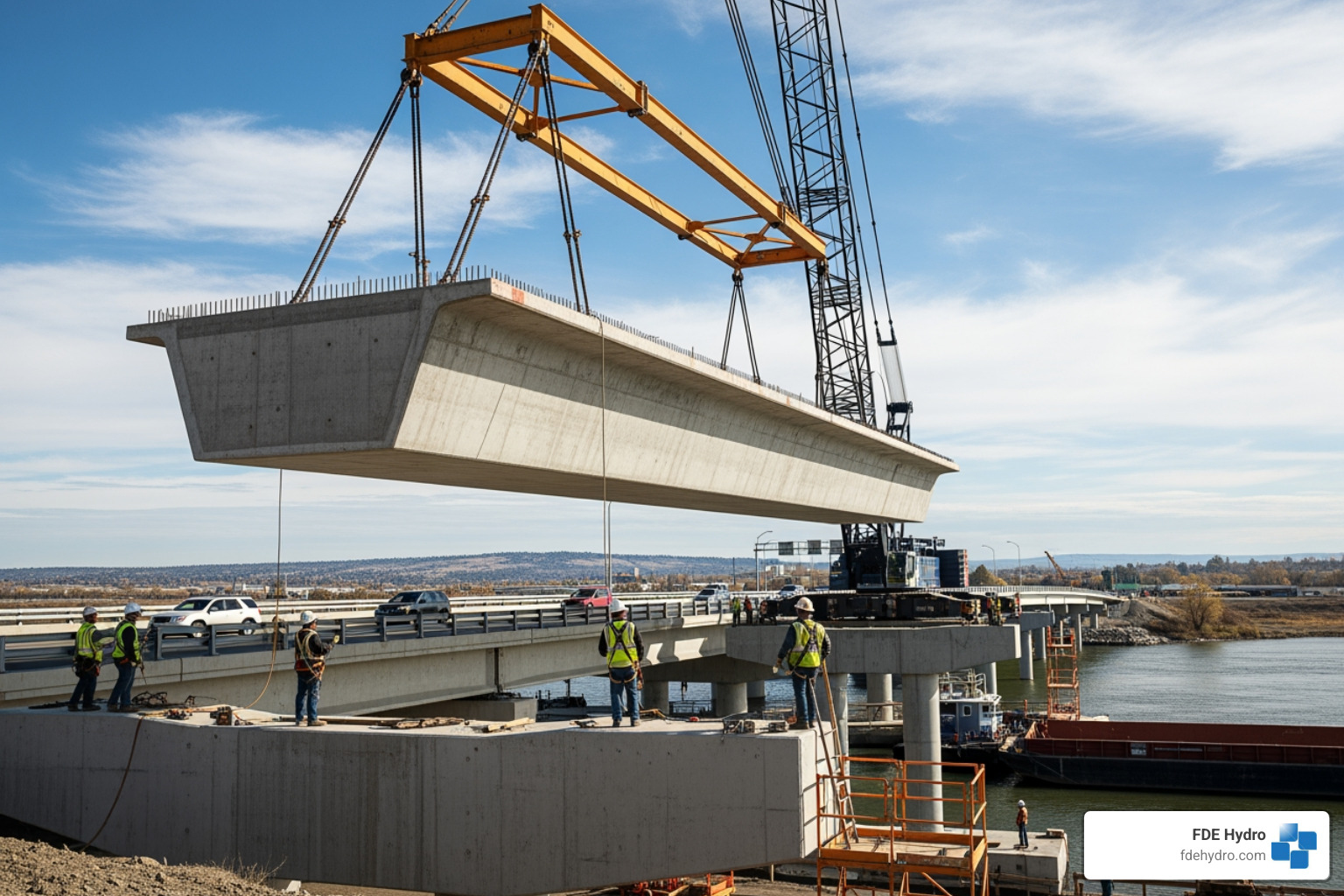
Beyond buildings, the same principles apply to civil infrastructure. Prefabricated Bridge Elements and Systems (PBES), a form of modular precast, are structural components built offsite to reduce onsite construction time and mobility impact. The use of PBES improves site constructability, total project delivery time, material quality, product durability, and work-zone safety, while also reducing traffic impacts and weather-related delays. This means less disruption for communities and a faster return to full functionality for vital transportation networks.
Superior Quality and Precision
One of the cornerstones of modular precast construction is the unparalleled quality control it offers. When concrete elements are cast in a factory, they are produced in a controlled environment, shielded from the unpredictable whims of weather conditions. This means consistent temperatures, humidity levels, and curing processes, all contributing to a higher-strength, more uniform product.
Unlike cast-in-place concrete, where variables on a construction site can lead to inconsistencies, modular precast benefits from a high degree of quality control. This includes precise measurement of materials, meticulous mixing, and continuous monitoring throughout the casting and curing stages. The result is a high-strength concrete product that meets exact specifications every time. This rigorous control significantly reduces the chances of on-site errors and rework, saving both time and money. Our article on Precast Concrete Advantages digs deeper into how this controlled environment translates to superior structural integrity and longevity.
Improved Durability and Structural Resilience
Modular precast concrete is not just fast and precise; it’s also incredibly tough. The controlled manufacturing process yields a product with exceptional durability and structural resilience, making it ideal for critical infrastructure and long-lasting buildings.
Precast concrete offers unparalleled resistance to fires, natural disasters (such as extreme heat, cold, rain, wind, and even seismic events), insects, and mold. This inherent resilience is a major advantage, especially for structures that must withstand the test of time and environmental stresses. For example, in data centers where structural integrity is paramount, precast concrete can accommodate loads that approach 400lb/ft2 on floors and 350 lb/ft2 on roofs, thanks to innovations like deep-stem double-tees. These robust components can span over 18 meters, providing the large, clear-span spaces often required in such facilities.
The high-strength concrete and meticulous manufacturing process contribute to a longer service life and lower maintenance requirements over the lifetime of the structure. This long-term performance makes modular precast an excellent investment for projects where longevity and minimal upkeep are key considerations, aligning perfectly with the goals of next-gen civil solutions.
Sustainability and Environmental Benefits
In an era where sustainable construction is not just a buzzword but a necessity, modular precast construction shines brightly. Its factory-based production inherently leads to several environmental advantages.
One of the most significant benefits is material savings. For instance, pre-stressed hollow-core slabs, a common modular precast component, can save up to 45 percent in concrete compared to reinforced concrete floors cast in a 3D mold or a plain cast-in-situ reinforced slab. This reduction in material also means a decrease in the amount of pre-stressing steel needed, potentially cutting it by 30 percent due to the lower self-weight of hollow core slabs. In an average apartment, using pre-stressed hollow core slabs can mean savings of about 14 tons of concrete and more than 250 kg of steel – that’s a substantial reduction in resource consumption!
Furthermore, modular precast contributes to energy efficiency. Insulated precast concrete wall panels, for example, can achieve R-values of R-20 or more, depending on the type and thickness of insulation (e.g., EPS, XPS, or polyisocyanurate). These panels can work as the only load-bearing walls, providing excellent thermal performance and reducing heating and cooling loads, especially crucial for energy-intensive facilities like data centers.
The factory setting also allows for better waste management and recycling of materials, reducing overall construction waste that often plagues traditional sites. Less site disruption, reduced noise pollution, and fewer vehicle emissions from prolonged on-site work further underscore the environmental advantages of modular precast. We believe this approach is fundamental to Sustainable Infrastructure Development.
Key Components and Technologies in Modern Systems
The versatility of modular precast lies in the wide array of components and the cutting-edge technologies that drive their production. From simple panels to complex volumetric units, modern systems leverage innovation to deliver customized, high-performance solutions.
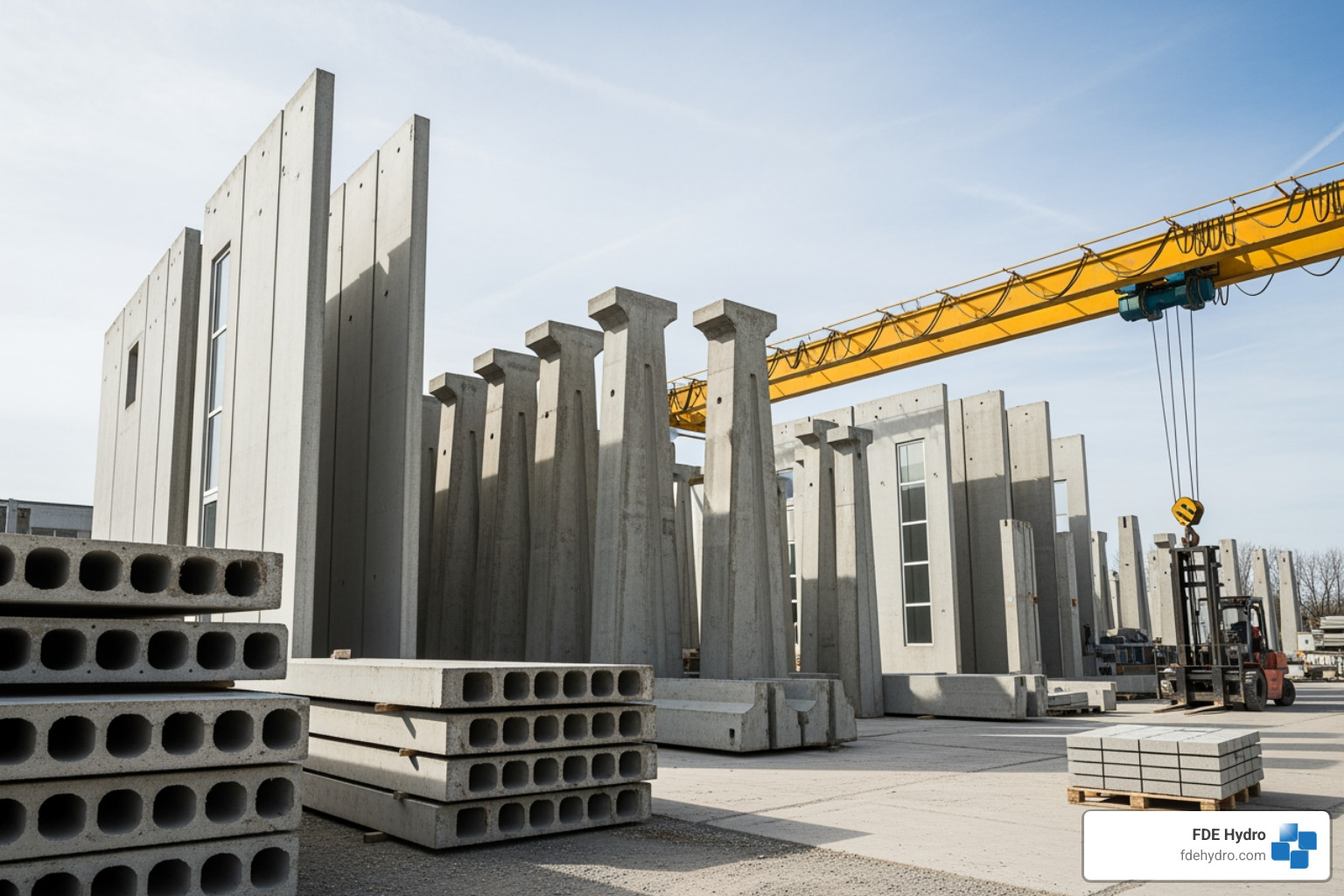
The Building Blocks: From Panels to Pods
At its heart, modular precast construction relies on a diverse range of standardized and custom-made components. These “building blocks” are manufactured with precision in controlled environments, ready for assembly.
- Pre-stressed hollow-core slabs: These are a staple for floors and roofs, capable of spanning from 8 meters to 12 meters. Their hollow cores reduce weight while maintaining structural integrity, leading to material savings.
- Insulated sandwich panels: Comprising two concrete wythes separated by an insulating layer, these panels provide excellent thermal performance (R-values of R-20 or more are achievable) and can serve as both the structural envelope and finished exterior/interior walls.
- Architectural cladding: Beyond structural elements, modular precast allows for highly customizable architectural panels that can be used to clad building facades, offering aesthetic versatility with various finishes and textures.
- Volumetric 3D modules: These are essentially entire rooms or sections of a building cast as a single unit. While they can be heavy (over 30 tons for room-sized modules), they offer extreme speed on-site. Historically, these have been predominant for prison cells, with structures as high as 10 to 12 stories. Their use has expanded to school classrooms, hotel/motel rooms, and even bathroom pods, arriving at the site nearly complete and outfitted. You can find an overview of precast components that illustrates this diversity.
The Role of Technology in modular precast Production
The precision and efficiency of modular precast wouldn’t be possible without advanced technology and automation. The modern precast plant is a hub of innovation, where digital design meets robotic manufacturing.
- Automation and Robotics: From automated batching plants to robotic rebar placement and concrete pouring, automation streamlines the production process, ensuring consistency, speed, and safety. This reduces manual labor and minimizes human error.
- Building Information Modeling (BIM): BIM is crucial for the design and coordination of modular precast projects. It allows for the creation of detailed 3D models of components, facilitating clash detection, optimizing material usage, and ensuring precise fit-up on-site.
- 3D Engineered Models and Digital As-Builts: These technologies improve the accuracy of design and documentation, providing a digital twin of the project that can be used from initial design through to facility management. This level of detail is a significant leap from traditional blueprints.
These technological advancements optimize the entire production process, from design to the construction site, enhancing efficiency, quality control, and the overall deliverability of complex projects. We explore these innovations further in our discussion of Precast Concrete Technology.
Aesthetic Freedom and Customization
A common misconception about modular precast is that it leads to “cookie-cutter” or aesthetically limited buildings. We are here to tell you that is absolutely not the case! Modern modular precast offers remarkable design flexibility and customization options, allowing architects and designers to release their creativity.
Precast concrete is incredibly responsive to the designer’s needs. Colors, shapes, and textures are often more attainable with precast than with competitive materials. We can achieve a vast array of finishes:
- Formliners: These reusable molds can impart intricate patterns, textures, or even simulated natural materials (like wood or stone) onto the concrete surface.
- Textures: From smooth and polished to sandblasted, exposed aggregate, or ribbed, the surface texture can dramatically alter the appearance.
- Colors: Pigments can be added to the concrete mix to achieve a wide spectrum of colors. Additionally, exterior finishes can be stained with UV-resistant, vibrant colors, offering options like simulated ashlar, brick, barnboard, or block.
- Aggregate exposure: By varying the size and type of aggregate and the depth of exposure, we can create unique visual effects, from subtle speckles to bold, textured surfaces.
This level of customization means that modular precast can be used to create visually stunning and unique structures, dispelling any myths about limited design. Just look at how a Breezy Brazilian Prefab Is Made From Six Tiny Modules – Dwell and you’ll see the aesthetic possibilities are virtually endless.
Applications Across Industries: Where Modular Precast Shines
The beauty of modular precast lies in its adaptability. While it excels in projects requiring speed and repetition, its inherent strengths make it suitable for a surprisingly diverse range of applications, from critical infrastructure to modern housing solutions.
Accelerating Critical Infrastructure
For large-scale public works and vital infrastructure, modular precast is a game-changer. It’s about minimizing disruption, accelerating completion, and ensuring long-term resilience.
- Prefabricated Bridge Elements and Systems (PBES): As mentioned earlier, PBES are critical for Accelerated Bridge Construction (ABC). By building bridge components off-site, we can significantly reduce the time traffic is impacted, improve work-zone safety, and minimize weather-related delays. This method is gaining traction across North America, including projects in the U.S. and Canada, for rapid bridge replacement and rehabilitation. The FHWA’s information on Prefabricated Bridge Elements and Systems highlights how this approach improves site constructability, total project delivery time, material quality, and product durability.
- Water Control Systems: This is where our expertise at FDE Hydro™ truly comes into play. Our patented “French Dam” technology uses modular precast concrete for building and retrofitting hydroelectric dams and other water control systems. This approach significantly reduces construction costs and time compared to traditional methods, especially in regions like North America, Brazil, and Europe where we operate. The rapid installment of module precast civil infrastructure is changing how we approach vital water management projects. You can learn more about this innovative approach in our article on Modular Dam Construction.
Building the Future of Data and Housing
The rapid expansion of the digital world and the ongoing demand for affordable, quality housing present immense challenges that modular precast is uniquely positioned to address.
- Data Centers: The data center boom, fueled by AI and cloud computing, demands unprecedented speed-to-market. With nearly 5,000 operating data centres across North America and hundreds more in development in the U.S. and Canada, the pressure is on. As a McKinsey report indicates, the global capital expenditures for data centers and supporting infrastructure are projected to reach $6.7 trillion over the next five years. Modular precast offers the solution: rapid assembly, ability to accommodate heavy load requirements (up to 400lb/ft2 on floors), and high R-value insulated wall panels (R-20 or more) crucial for maintaining precise temperature control. Its resilience to fire and natural disasters also provides peace of mind for critical operations.
- Multi-story Housing and Commercial Buildings: The efficiency of modular precast is not limited to specialized facilities. It’s a proven method for constructing multi-story apartment buildings, hotels, and classrooms. Modular precast units have been successfully used for prison cells for many years, expanding to school classrooms and hotel/motel rooms. These units can be outfitted and finished at the plant, arriving at the site nearly complete, drastically cutting down on construction time and enabling quicker occupancy.
Navigating the Challenges and Limitations
While the advantages of modular precast are compelling, like any construction method, it comes with its own set of considerations. Understanding these challenges upfront allows for better planning and more successful project outcomes.
Logistical Problems: Transportation and Handling
The very nature of modular precast—large, pre-fabricated elements—introduces specific logistical problems.
- Module weight and size limitations: Room-sized 3D precast concrete modules can weigh more than 30 tons. Transporting such heavy and often oversized components requires specialized equipment and careful planning. The sheer dimensions of panels and modules can be limited by road regulations, bridge clearances, and vehicle capacities.
- Site access: Even if elements can be transported, the construction site itself must be accessible for large delivery vehicles and heavy lifting cranes. Tight urban sites or remote locations can pose significant challenges.
- Specialized transport and crane capacity: The handling and erection of heavy modular precast elements demand powerful cranes and experienced operators. This can add to the project cost and require meticulous scheduling.
Design and Connection Complexity
The factory-controlled precision of modular precast means that design decisions need to be finalized much earlier in the project lifecycle compared to traditional construction.
- Early design freeze: Changes later in the design process can be costly and cause significant delays, as molds may already be fabricated or components produced. This necessitates a more thorough and collaborative design phase upfront.
- Importance of precision: Every connection point, every utility penetration, and every dimension must be exact. Tolerances are much tighter in modular precast, requiring meticulous detailing and coordination between the design team, the precast manufacturer, and the on-site assembly crew.
- Force-fitting connections: The connection details between modular precast elements are critical for structural integrity and must be carefully engineered for force-fitting and durability. These connections need to be robust, efficient to assemble on-site, and capable of transferring loads effectively.
- Collaboration between teams: Successful modular precast projects rely heavily on seamless communication and collaboration among all stakeholders, from architects and engineers to the precast plant and the installation crew. This integrated approach ensures that all potential issues are addressed during the design phase, long before concrete is poured.
| Feature | Modular Precast | Cast-in-Place Concrete |
|---|---|---|
| Flexibility | Design freeze required early; highly customizable within module constraints | High design flexibility; changes easier during construction |
| Speed | Rapid on-site assembly; concurrent off-site production | Slower on-site construction; sequential operations |
| Quality Control | Superior (factory controlled environment) | Variable (site conditions, weather dependent) |
| Initial Planning | Requires extensive upfront design and coordination | More adaptable during construction |
| Site Impact | Minimal disruption, noise, waste | Significant site activity, noise, waste |
| Weather Dependency | Low (factory production) | High (site pouring and curing) |
| Labor Needs | Lower on-site labor; skilled factory workforce | Higher on-site labor; less specialized skill often used |
| Cost | Lower overall project cost (due to speed, efficiency) | Can be higher due to longer timelines, site overhead |
| Durability | Excellent (high-strength, controlled curing) | Good (can vary with site conditions) |
Frequently Asked Questions about Modular Precast Construction
What is the main difference between modular precast and traditional construction?
The primary difference lies in where the building elements are created. Modular precast involves manufacturing components like walls, floors, beams, and even entire 3D modules in a controlled factory setting before transporting them to the site for assembly. This “off-site” approach contrasts sharply with traditional construction, like cast-in-place concrete, which involves forming, pouring, and curing concrete directly on-site.
Traditional methods are slower, more susceptible to weather delays, and can have more variability in quality due to changing site conditions. Modular precast, by moving much of the work into a controlled environment, ensures consistent quality, faster timelines, and reduced on-site disruption.
Is modular precast only for simple, boxy buildings?
Not at all! This is a common misconception we love to dispel. While modular precast is incredibly efficient for repetitive structures like hotel rooms, prison cells, or data centers, modern precast technology offers vast aesthetic flexibility. Through the use of various molds, formliners, aggregates, and specialized finishes, architects can achieve a wide range of complex shapes, intricate textures, and vibrant colors.
We can simulate natural stone, brick, or wood, create unique patterns, or achieve sleek, modern facades. The ability to embed architectural elements directly into the precast during manufacturing means that “customization” is not an afterthought, but an integral part of the design process. The result is structures that are both highly functional and visually appealing, dispelling the myth of “cookie-cutter” buildings.
How long can a modular precast structure last?
Modular precast concrete structures are exceptionally durable and designed for a very long service life. Produced with high-quality, high-strength concrete in a controlled environment, they are inherently more robust and consistent than their cast-in-place counterparts. This controlled production environment leads to concrete that is stronger, denser, and less permeable, making it highly resistant to environmental degradation.
Precast concrete offers unparalleled resistance to fires, natural disasters, insects, and mold. With proper design and maintenance, modular precast structures can easily last for many decades, often 50-100 years or more, requiring minimal upkeep throughout their lifespan. This longevity makes them a highly sustainable and cost-effective choice for long-term infrastructure and building projects.
Conclusion
As we’ve explored, modular precast isn’t just a construction trend; it’s a fundamental evolution in how we build. From accelerating project timelines and delivering significant cost savings to ensuring superior quality, enhancing durability, and championing sustainability, the benefits are clear and compelling. We’ve seen how it’s revolutionizing diverse sectors, from the critical infrastructure of bridges and dams to the booming demand for data centers and housing across North America, Brazil, and Europe.
At FDE Hydro™, we believe in the power of innovation to solve complex challenges. Our work with patented modular precast technology, like the French Dam, is a testament to the transformative potential of this method in renewable energy and water control systems. By embracing modular precast, we’re not just building faster; we’re building better, stronger, and more sustainably for the future.
We invite you to learn more about how modular precast can benefit your next project. Explore advanced modular precast solutions for dams and find how we’re shaping the future of infrastructure, one precise, factory-made component at a time.
